
The short answer
On paid plans, Scope asks your most important questions again every week on ChatGPT, Gemini and Claude. If a competitor starts being recommended, or you gain or lose ground across assistants, you get an alert that week. If nothing moves beyond normal variation, there's no alert. That's a quiet week, and it is the usual result.
What the pulse checks
The pulse re-asks a small set of your key questions from the last full audit, so the answers are comparable. It looks for four kinds of movement:
- you started being recommended more;
- you started being recommended less;
- a competitor started being named;
- a competitor dropped out.
It only flags movement that repeats across assistants since your last audit. One answer changing on its own isn't enough.
What an early signal means
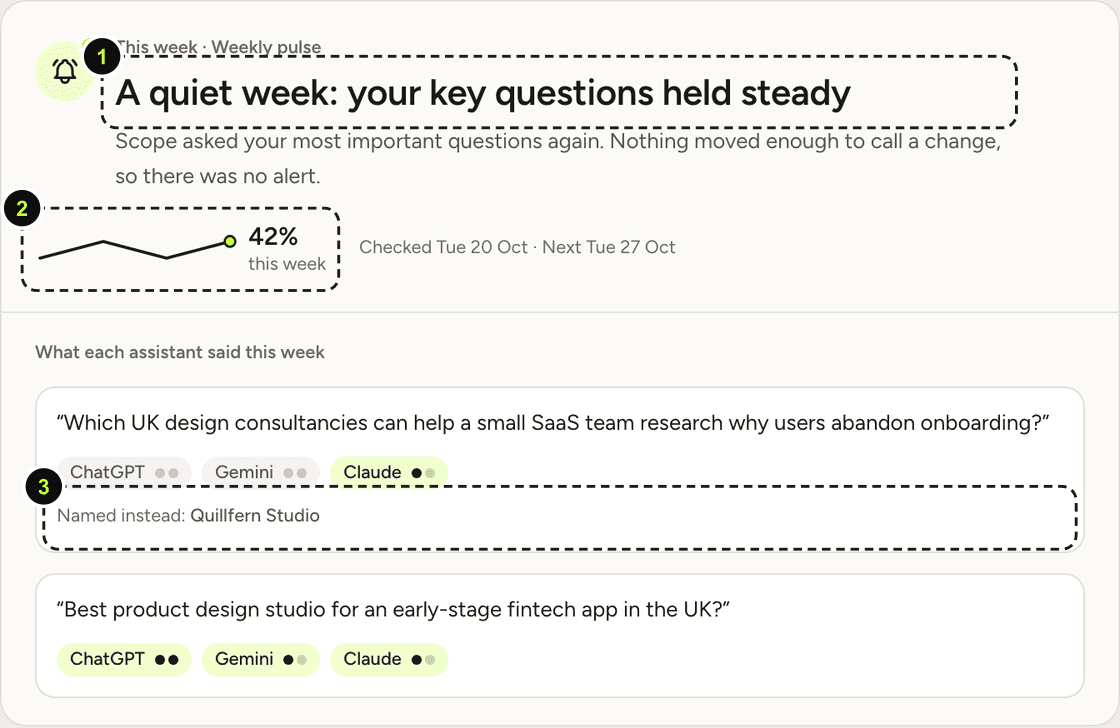
A pulse alert is called an early signal on purpose. It's a reason to look, not a conclusion. The panel puts it plainly: movement that repeated across assistants since your last audit, which your next monthly audit confirms or rules out. Under each key question you'll see what each assistant said that week and, where you weren't recommended, who was named instead. The next monthly audit keeps the full answers and the pages they cited.
Reading a quiet week
Most weeks, the panel will say "A quiet week: your key questions held steady". That means Scope asked again and nothing moved enough to call a change, so it didn't email you. AI answers vary a little all the time; a quiet week tells you that variation stayed within normal bounds.
For agencies, quiet weeks are worth passing on. "We re-checked your key questions four times this month and nothing moved" is reassurance a client can use. The monthly summary in the report and the PDF writes that line for you, in the form "Between audits, Scope re-checked your key questions 4 times. Nothing moved enough to call a change."
When there's no pulse
| You see | Why |
|---|---|
| "Your first weekly pulse runs [date]" | The pulse starts once your first full audit is saved. |
| "No pulse this week", because your monthly audit is due | The monthly audit asks every question, so nothing is missed and the pulse steps aside. |
| "No pulse this week", because your monthly audit just ran | There's a fresh full result; a pulse would add nothing. |
| "The pulse is waiting for questions it can compare with your last audit" | The pulse only compares like with like. |
| "Monitoring is paused, so the weekly pulse is too" | Pausing monitoring pauses the pulse too. |
What the pulse is not
It isn't daily or real-time monitoring, and it isn't a full audit. It's a weekly check on the questions that matter most, designed so you hear about real movement within a week instead of a month.
What this can't tell you
- The pulse samples a subset of questions; the monthly audit remains the full measurement.
- A signal shows that answers changed, not why they changed.
Sources
Primary sources first. Research papers are cited with their limits. Every source was re-opened on the date shown.
- 1Scope product facts and limitations
The InnerView · 24 September 2026 · checked 25 September 2026
Supported assistants, free check scope, monitoring rhythm and stated limitations, including that Google AI Overviews and Perplexity are not currently measured.
- 2Scope methodology
The InnerView · checked 25 September 2026
How Scope defines recommendation rate and visibility, compares audits, repeats questions and states its limits.
Get the next guide by email
Short emails on how ChatGPT, Gemini and Claude recommend businesses: the new piece, one real answer we saw, and one fix you can make. Unsubscribe any time.